Becoming a grandparent can be more complex than expected and often differs from past parenting experiences.
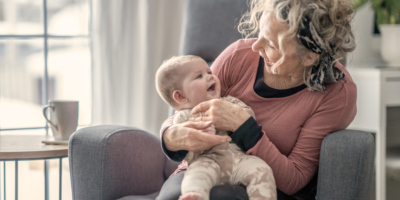
Information for grandparents
Like any milestone in life the feelings we experience may be mixed. Some grandparents are surprised to feel a mixture of joy and grief, excitement and sadness. To suddenly shift a generation from parent to grandparent can be confronting.
As grandparents, you may have a lot to offer in terms of knowledge and experience, after all – you’ve raised children yourself.
However, whilst the fundamentals of caring for a baby have not changed (eg. feeding, changing, settling), the context of motherhood has. For example young adults now have far more choice in the role that both parents play and often have options about work and its integration with parenthood. They also have far more access to information – from others, experts on hand, and may choose to adopt modes of parenting that you cannot quite relate to.
I just can’t understand why she doesn’t need me.
Offering advice
Sometimes the birth of grandchildren into the family will bring the family closer, particularly if there are offers of practical and emotional support which are acknowledged, accepted and appreciated. However, very often this may not be the case, as new parents may strive to discover parenting for themselves. They are often keen to trial and tailor their own approaches, and with the easy access to information nowadays, they are often likely to seek advice from online or recognised parenting experts, as opposed to turning to their own parents or in-laws.
We’ve offered to help out and tried offering advice – but they just don’t seem to listen. You would think we have no idea.
Sometimes it may be best therefore to simply listen, without offering solutions or advice unless it is asked for. If you offer advice and you feel that that this is not listened to or valued, try not to take this as a personal rejection. Rather try and see it as the new parents finding their own way. Often the more you assert unwanted advice, the more likely this will be rejected, and it may create distance between you. Try and see this as the new parents beginning to establish their own identity as parents.
Relationship adjustments
Parenthood can also bring changes to relationships and relationship dynamics. Assumptions about the roles that everyone will play as they step into the new roles as parents and grandparents may, and do, vary greatly. This is not only between families, but within families as even parents may have differing views on the degree of involvement of grandparents in the lives of their children.
If not recognised and seen within the context of expectations this can bring additional stress and tensions, fuel disagreements and lead to disappointments. It can be highly emotional and distressing. Here are a few tips that may be helpful:
Try to remain open-minded
Try and explore pathways at a time when things have not reached a point of tensions.
Be prepared to take a step back at times and let the transition unfold in its own time.
You may also need to adjust your expectations to protect yourself from disappointment and grief.
It may also be important that you continue to maintain important interests and hobbies of your own, to reduce the focus and impact of the absence of the family involvement you may have hoped for.
Continue to offer help and support
There are many ways that you can offer support to new parents. For example offering to look after the baby, whilst being mindful to not take over and be ‘the expert’ can be invaluable. Similarly, offer to look after other children to give everyone a break and also give these children some important attention at a time when much attention may be directed towards the new baby.
Providing practical support such as through cooking and cleaning without expecting anything in return can also be invaluable for new parents. Encouraging and creating opportunities for the mother and father to nurture themselves can also be a good strategy, as it acknowledges that this can be a difficult time for them and that you are there to support them.
Whatever types of support you may decide to offer, remember that even if these are not accepted, it’s important to keep offering, as sometimes new parents may find it difficult to accept help.
Supporting someone with mental health concerns
If one of your children or daughter/son in law is struggling with a mental health problem during pregnancy or in the year following the birth, it is important to acknowledge that they may be struggling and this may impact on your interractions with them.
I realised that I had postnatal depression after an argument with my mother in law – I realised that I was saying hurtful things to people (that I did not mean) as a way of releasing my anger/frustration with myself.
It is also important to consider that if your family member may be struggling as a result of the symptoms that they may be experiencing, and hence may not able to simply ‘get on with it’.
My father would say ‘you’re a mum now – just get on with it’ and I tried so hard, but nothing helped. I just couldn’t shake it off.
Offering practical and emotional support can be invaluable. This can include offering to help with the baby or caring for other children, assisting by cooking some meals and taking these over, or assisting with chores or errands. It is likely to be difficult for the person to ask for help, so a ‘no fuss approach’ to offering help can be an effective way to support the person whilst also letting them know that you are there for them.
If the person is very unwell and suffering from severe mental health issues, this will ultimately impact on their ability to function from day to day, and attend to the needs of the baby. In this instance you may need to take a very proactive role, you may need to step in and take on high levels of responsibility to help manage the household.
Be prepared however, that often women, or men, may not want to acknowledge or admit to themselves or others that they may be struggling, and may even refuse offers of help. Again, whilst this may feel disappointing and can be hurtful, in this instance, try and understand that this is part of their journey to self-awareness and acceptance, and pushing the issue may only increase their resistance to offers of help, but may also create social distance.
In summary, the transition to grandparenthood is not always as straight forward as we anticipated, and is likely to vary greatly from what it was when you had young children.
Be prepared to keep an open mind, and be aware of your expectations as everyone’s role unfolds, and whether your offers of help are accepted or not, just let them know that you are there for them. In the meantime, put your energy into yourself or areas of life that are satisfying for you, and however difficult, try not to take it personally.
