Trying to conceive

At COPE, we’re here for you from the very beginning. Access trusted guidance, expert information, and compassionate support as you navigate the journey of trying to conceive.

Coping with loss

Coping with loss is deeply personal and painful — COPE offers gentle support, guidance, and understanding to help you navigate this difficult time.

Pregnancy

Navigate your pregnancy with confidence using COPE’s expert advice, emotional support, and reliable information tailored for every step of the journey.

Birth

Providing you with evidence based information to help prepare and nurture yourself before, during and following birth

New parents

Early parenthood can be joyful, challenging and everything in between. COPE provides you with expert guidance and real insights to help you feel seen and supported every step of the way.

Family, Friends & Community

Whether you're a partner, friend, or family member, COPE provides guidance and support to help you care for your loved one and yourself through every stage of parenthood.

Workplace support

COPE provides guidance and resources to help workplaces support the emotional wellbeing of expecting and new parents with care and understanding.

COPE Directory

If you're going through a tough time, you're not alone. The COPE Directory is a supportive first step toward finding the right help, close to home and tailored to your needs

About us

At COPE, we believe every parent deserves access to compassionate support and reliable information. Our mission is to raise awareness, reduce stigma, and empower families facing perinatal mental health challenges.

Get involved

Your support can make a lasting impact. By donating to COPE, you help to provide vital support, resources, and research for families facing perinatal mental health challenges. Together, we can make sure no parent is alone.

Getting help

Understand when to seek help, how to take the first step of talking to someone, types of support available, plus how to find specialised perinatal mental health support near you.

As we know, pregnancy brings with it lots of changes, all of which can impact upon your emotional health in pregnancy.  The range of physical changes and perceived lifestyle changes are likely to lead to mixed emotions, and even occasional doubts.  Even negative thoughts and dreams are normal as you are ‘entering a new zone of life’ – that of parenthood.
 

Adjusting to the changes of pregnancy

The changes that lie ahead that you may now start to be exposed to can lead you to feel some degree of worry or apprehension.  Even if you planned to become pregnant, or if you became pregnant quickly, you may start to realise the significance. You may even begin to question whether this is the right time, or what type of parent you will be. You may question whether you will be able to manage financially and the impacts on your relationships with your partner, family and friends.

When considering the significant and long-term impacts on your life, this can all be seen as completely normal and natural.  After all, it’s normal to feel some level of stress when there is impending change and you cannot prepare or control everything or know what to expect.
 

Stress in pregnancy

Some degree of stress in our lives is normal. However, once this stress starts taking over, this can become distress. Distress can impact on your ability to function at your full capacity.

Often stress is associated with a feeling of losing control or not having the resources or ability to manage challenges that lie ahead.

Some factors that may increase stress in pregnancy may include:

  • Having a stressful or unplanned pregnancy
  • Having a prior negative pregnancy, birth or early parenthood experiences (such as inadequate sleep, breastfeeding difficulties, or an unsettled baby)
  • Experiencing complications in the pregnancy
  • Being a single parent or adolescent may also cause you to feel more stressed or overwhelmed, as you contemplate how you will manage
  • Experiencing relationship difficulties with your partner can also greatly increase your feelings of distress and concern for the relationship, as well as your feeling of security for your growing family.

There are a range of strategies that can be helpful and assist in alleviating your feelings of stress or apprehension.
 

Be aware of your expectations

It’s important to be aware of your expectations of pregnancy, birth and becoming a parent. Ask yourself if these are realistic? Are you putting additional pressure on yourself?  For example, are you assuming that everything will be perfect – just like the TV advertisements?  Are you putting expectations on yourself that you wouldn’t expect of others?  Are you assuming that your negative experiences in the past will automatically reoccur?

You can also take this time to identify and establish your support networks around. Also, consider how this can alleviate your stress through providing you with emotional and practical support.

It’s important that you don’t expect too much of yourself.  Be aware that there will be lots of challenges ahead, for which there are not necessarily wrong or right ways of doing things and no definite answers.

I dreamed of being the ‘perfect mother’, of breastfeeding, of never using formula. I would have a natural birth – a c-section was out of the question … This ended up far from reality, but made harder for me because my hopes and expectations were so high.

Avoid alcohol and drugs during pregnancy

It is also important to be aware of any unhelpful strategies that you may be doing to relieve feelings of stress.  One of those is drinking alcohol or taking other drugs to help reduce your feelings of stress, tension or anxiety.  While having a drink or two or using a substance may initially make you feel more physically relaxed, it is not likely to be helping in the longer term. In fact, can make things much worse.

Very importantly, alcohol and drugs can impact on the health growth and development of your growing baby. It is therefore recommended that women do not drink alcohol at all or use any substances (other than those prescribed by a health professional) during pregnancy.  If you are finding it difficult to cope or get through the day without alcohol or drugs, it is important that you seek professional help immediately.  This can help you find other ways of managing stress and your emotional health in pregnancy that won’t put you or your baby (or other children) in danger.
 

Address relationship issues

If you are experiencing relationship concerns or difficulties, it can also be very helpful to receive counselling, before the arrival of the baby. This can assist you both to identify areas that need attention. It can also help stop things from getting worse or further problems developing.  Getting help now is also likely to be easier than waiting until the baby arrives, when practically it will be more difficult to see a counsellor.
 

Take the pressure off

Try and remember that parenting is not an exact science – it’s a process.  You will learn along the way what works for you, your baby and your family.  In the meantime, it is a good time to focus on what you can control.  Look after your physical health through eating well and keeping fit.  Nurture your mental health and emotional health in pregnancy by taking some time out to do things you enjoy and help you to relax. Also, share your concerns and experiences with supportive people around you.

Looking for more helpful tips and information?

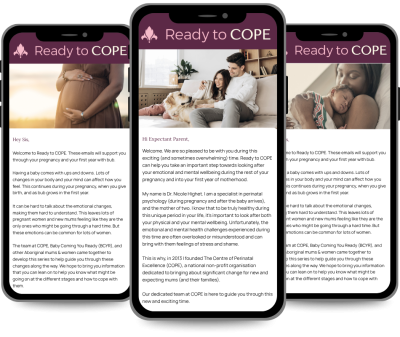
Sign up to Ready to COPE for free, supportive weekly emails throughout your pregnancy.  Ready to COPE is available for new and expectant mums, dads and partners.

Ready to COPE smartphone mockup
Be safe online
Dismiss Alert

Click the Exit Site button or press "Esc" on your keyboard to exit this site quickly. Click here to learn how to keep your identity safe online.

Quick exit
Hide