Trying to conceive

At COPE, we’re here for you from the very beginning. Access trusted guidance, expert information, and compassionate support as you navigate the journey of trying to conceive.

Coping with loss

Coping with loss is deeply personal and painful — COPE offers gentle support, guidance, and understanding to help you navigate this difficult time.

Pregnancy

Navigate your pregnancy with confidence using COPE’s expert advice, emotional support, and reliable information tailored for every step of the journey.

Birth

Providing you with evidence based information to help prepare and nurture yourself before, during and following birth

New parents

Early parenthood can be joyful, challenging and everything in between. COPE provides you with expert guidance and real insights to help you feel seen and supported every step of the way.

Family, Friends & Community

Whether you're a partner, friend, or family member, COPE provides guidance and support to help you care for your loved one and yourself through every stage of parenthood.

Workplace support

COPE provides guidance and resources to help workplaces support the emotional wellbeing of expecting and new parents with care and understanding.

COPE Directory

If you're going through a tough time, you're not alone. The COPE Directory is a supportive first step toward finding the right help, close to home and tailored to your needs

About us

At COPE, we believe every parent deserves access to compassionate support and reliable information. Our mission is to raise awareness, reduce stigma, and empower families facing perinatal mental health challenges.

Get involved

Your support can make a lasting impact. By donating to COPE, you help to provide vital support, resources, and research for families facing perinatal mental health challenges. Together, we can make sure no parent is alone.

Getting help

Understand when to seek help, how to take the first step of talking to someone, types of support available, plus how to find specialised perinatal mental health support near you.

The first days and weeks following childbirth

As you prepare for birth, it is also helpful to think beyond labour and delivery. It is also helpful to also start to think about how you may be feeling emotionally during the first few days or weeks after your child is born, while you are recovering from birth.

This time can be filled with great joy, happiness and wonder. However, it is also not uncommon to also experience some emotional challenges. Making yourself aware now – before you give birth – of what these challenges may be. Doing so will help you to have realistic expectations of what this time may look like for you and be prepared for the hurdles that you may face.

Stay informed and feel reassured

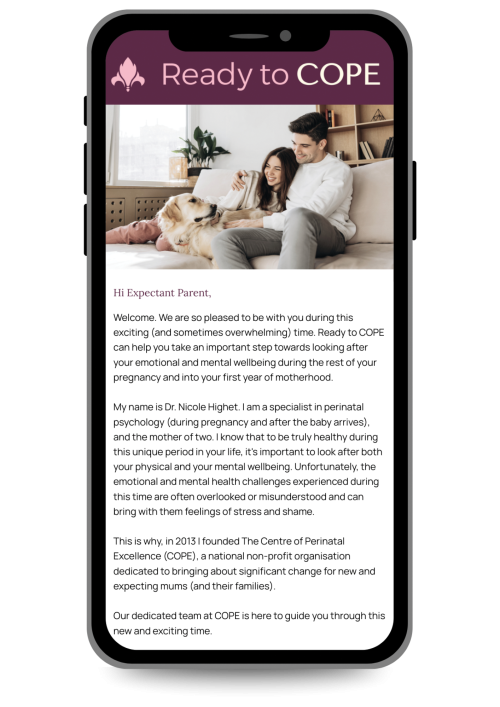
Ready to COPE is a free guide offering supportive weekly updates during pregnancy and the first 12 months after the birth of your baby.

Sign up now
Ready to COPE guide pregnancy and first year of parenthood

Recovery from birth

Physical and emotional recovery

In most cases giving birth, especially to your first baby, can be physically and emotionally exhausting – for both parents. Recovering from birth can take time.

For women there may be an experience of pain and discomfort following birth. Depending on the outcome of the birth it may take some time to recover physically from the birth process – particularly if you had experienced a traumatic birth and/or aftercare. Recovering from birth physical varies greatly from hours to days, weeks or even months. 

For partners also, the birth experience can be physically and emotionally draining. This can also take a toll on their feelings of stress and feeling exhausted.

It is important to give yourself time to recover.

Rest when possible

Where possible try and both get some rest whenever you have the opportunity. Creating opportunities for this in advance can be very helpful. For example, if partners are able to take some time off work to catch up on sleep and help with the settling of the new baby this benefits everyone.

Try and arrange some time just for yourselves each day – even if it is to have a shower, catch up on some sleep, go for a walk or read. If you have other children, where possible try and arrange for them to spend time with others initially. This can help to give you some time and space to get your energy levels back.

The Baby Blues

In the early days following birth, women may experience a temporary condition commonly known as ‘the baby blues’.

For women, the baby blues usually occur between the third to the fifth day after having their baby. It can leave them feeling very distressed and/or emotional. Often women describe feeling very teary, or sometimes irritable. These overwhelming feelings are completely normal and natural. They are due to the sudden change in your hormone levels following the birth.

The baby blues is very common. Up to 80 percent of women experience this, and you may experience the condition with one child but not another. They will usually disappear within a few days, and there is generally no need for any treatment other than understanding, rest and support.

However, if these symptoms do not pass on their own and continue on, it may be a sign of another type of mental health condition like postnatal depression or postnatal anxiety. In this case, it is important to seek help.

"My worries didn’t start until I got home really, while in hospital I had the classic baby blues symptoms but they never really seemed to go away entirely."

Too often women delayed seeking help for what was postnatal depression and or anxiety. This can be because they thought it was simply the baby blues, and that it would go away on its own. The faster you seek advice about this and if there is a need for treatment, the faster you will be able to get on top of this, which is important for you and your family.

Learn more about postnatal anxiety and depression

Find help and support near you

Your postcode
COPE Directory Map Support Block
Be safe online
Dismiss Alert

Click the Exit Site button or press "Esc" on your keyboard to exit this site quickly. Click here to learn how to keep your identity safe online.

Quick exit
Hide