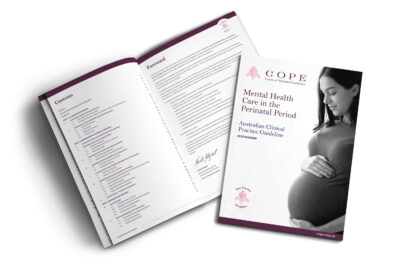
Access the full Guideline and summary information for Midwives.
Screening for depression and anxiety and assessing psychosocial risk factors are integral parts of antenatal care that should be offered to all women. It is also important that women receive psychosocial support.
Screening and assessment
Before screening and assessment
Make sure that appropriate follow-up care is available, if required, including for situations where there are concerns for the safety of the woman, the baby or other children in the woman’s care.
Identify health professionals from whom you can seek advice, clinical supervision or support regarding mental health care in the perinatal period.
Providing woman-centred care
Give all women information about the risk factors that increase the likelihood of experiencing a mental health condition during pregnancy.
Explain that depression and anxiety are common in pregnancy and that screening and assessment is part of usual pregnancy care. Results will remain confidential, unless there is a perceived or actual risk of harm to the woman or her baby, as there is a duty of care for this to be communicated.
Consider who should be present so that the woman feels safe during screening and assessment. While the presence of significant other(s) is often helpful, be sensitive about whether it is appropriate to continue with psychosocial assessment while they are in the room.
Only screen for family violence when alone with the woman.
Screening for depression and anxiety
Why — In Australia, one in ten women experience depression during pregnancy and one in five experience anxiety in late pregnancy. Anxiety disorders frequently occur with depression.
When — Conduct screening as early as practical in pregnancy and at least once later in pregnancy, or at any time if clinically indicated.
How — The Edinburgh Postnatal Depression Scale (EPDS) is the recommended tool for screening for depression. It is usually completed by the woman, preferably without consulting others. The EPDS may also be administered verbally. As part of clinical assessment, use anxiety items from existing screening tools (e.g. EPDS Items 3, 4 and 5, Depression Anxiety Stress Scale (DASS) anxiety items and K-10 Items 2, 3, 5 and 6) and relevant items in structured psychosocial assessment tools (e.g. the Antenatal (Psychosocial) Risk Questionnaire (ANRQ)).
Cultural considerations — When screening Aboriginal and Torres Strait Islander women, consider use of translations and adaptations of the EPDS developed in consultation with women from Aboriginal communities. If use of the EPDS is considered inappropriate, involve Aboriginal health workers where possible. For migrant and refugee women, use appropriately translated versions of the EPDS with culturally relevant cut-off scores. If you and the woman do not speak the same language, involve an interpreter.
Responding to EPDS scores
- For a woman with an EPDS total score of 13 or more, arrange referral or ongoing care.
- For a woman with an EPDS score of 10 to 12, arrange repeat EPDS in 2–4 weeks and review existing supports.
- For a woman with a positive score on Question 10 of the EPDS, undertake or arrange immediate further assessment and, if there is any disclosure of suicidal thoughts, take urgent action in accordance with local protocol/policy.
Assessing psychosocial factors that affect mental health
Why — Psychosocial assessment allows identification of circumstances (past and present) that affect a woman’s mental health. The number and type of factors identified influences the care pathway.
When — Undertake psychosocial assessment in conjunction with screening for depression and anxiety.
How — Psychosocial assessment can be undertaken as part of the clinical interview and/or using a structured psychosocial assessment tool. If using a tool to assess psychosocial risk, administer the ANRQ together with questions exploring the presence of family violence and drug and alcohol use.
Cultural considerations — Consider a more conversational approach when assessing psychosocial risk among Aboriginal and Torres Strait Islander or migrant and refugee women, with involvement of Aboriginal and Torres Strait Islander health workers or multicultural health workers, where possible. Consider psychosocial risk factors that may be relevant to specific groups (e.g. lack of secure housing, experience of trauma).
Responding to assessment — Discuss with the woman the possible impact of psychosocial risk factors (she has endorsed) on her mental health and provide information about available assistance.
Administration of screening tools
Screening and assessment can be undertaken using digital and or pen-and-paper approaches (see resources section below).
When claiming Medicare Benefits Schedule (MBS) items, use of the EPDS and ANRQ is recommended. Screening and assessment needs to be offered and evidence of this must be documented.
Supporting emotional health and wellbeing
At every antenatal visit, enquire about the woman’s emotional wellbeing and provide access to information about emotional and mental health during pregnancy and the early postpartum period (see Resources section below).
Provide the woman with advice on lifestyle issues and sleep, as well as assistance in planning how this advice can be incorporated into their daily activities during pregnancy (see resources section below).
If a woman agrees, provide information to and involve her significant other(s) in discussions about her emotional wellbeing and care.
Medications in the perinatal period
It is not usually necessary for women to discontinue the use of antidepressants during pregnancy or breastfeeding but any medications should be discussed with the prescribing doctor.
There is a high risk of relapse if medications for mental health conditions are ceased. If a medication is ceased, this needs to be done gradually and with the advice of a psychiatrist.
Women with severe mental illness may benefit from referral for review of their medications.
This is an adapted Summary of the 2023 National Guideline for midwives.
To access the full National Guideline, click the button below.
Resources
Resources for women and their families
COPE website – The COPE website contains extensive information, fact sheets on perinatal mental health disorders and links to support services for women and their families.
Ready to COPE – A free email guide that provides information about emotional health and wellbeing across the perinatal period. Also available as an email series in multiple languages.
COPE Directory – COPE Directory includes services and professionals that have a special focus on emotional and mental health in pregnancy and the following the birth of a baby.
Resources for health professionals
COPE website – The COPE website contains extensive information, screening tools, online training programs and fact sheets specifically for health professionals.
Consumer resources – Health promotion resources including the Ready to COPE Guide posters can be accessed for promotion within your healthcare setting.
COPE online training – This free accredited online training is available for midwives (ten hours CPD).
