Health professionals play a key role in perinatal mental health risk assessment.

The perinatal period, including pregnancy and the following year, is a time of great change in a woman’s life. It is a time when it is common for women to experience a wide range of emotions. For many women, feelings of worry and stress resolve by themselves. But, with some women, pregnancy and early parenthood can trigger symptoms of more serious mental health problems. Health professionals play a key role in perinatal mental health risk assessment.
Some people may be more vulnerable to mental health disorders in the perinatal period. This can be due to a combination of biological, genetic, physiological or social factors.
The risk is greater for those who have had mental health problems before, do not have enough emotional or practical support or have been through difficult times (e.g. family problems, abuse or loss). Drug and alcohol use can also contribute to the development of mental health disorders.
Psychosocial risk assessment
Asking a series of questions can identify psychosocial risk. This enquiry aims to identify psychosocial risk factors without detracting from the normal experiences of pregnancy and motherhood or highlighting the potential for depression and related disorders to occur in the perinatal period.
When to assess for psychosocial risk
The National Perinatal Mental Health Guideline recommends that all women should be asked questions around psychosocial factors as early as practical in pregnancy and 6–12 weeks after a birth as part of normal care. If a woman confirms the presence of psychosocial factors, she should be asked whether she would like help with any of these issues.
How to assess psychosocial risk
Asking a series of questions which reflect known risk factors can help assess psychosocial risk. The National Guideline recommends that if a tool is used to assess psychosocial risk, the Antenatal Risk Questionnaire (ANRQ) is used. The ANRQ is a scale that calculates an overall risk score based on a woman’s response to a series of questions assessing aspects of psychosocial risk.
Access ANQR as a perinatal mental health risk assessment tool
Instructions of how to use the ANRQ, the original ANRQ questionnaire template and ANRQ scoring guide can be downloaded in the links below:
*Note: This is the original ANRQ questionnaire which does not contain questions to enquire about family violence, drug and alcohol use or adaption to the postnatal period (see below).
Assessing family violence, drug and alcohol use and adaption to the postnatal context
It’s important to recognise that the ANRQ did not include questions pertaining to family violence or drug and alcohol use. This is because these questions were asked at other times on the antenatal care process.
It is therefore recommended that these questions are also asked alongside the ANRQ as part of the perinatal mental health risk assessment process. To support this, we have added these questions to the existing ANRQ questionnaire (see links below).
For those health professionals assessing risk in the postnatal period, we also recommend asking additional items pertaining to adaption to the birth and postnatal period through the inclusion of three additional items. These are displayed in the postnatal questionnaire below.
ANRQ for fathers
iCOPE 2.0: Best practice in perinatal mental health digital screening
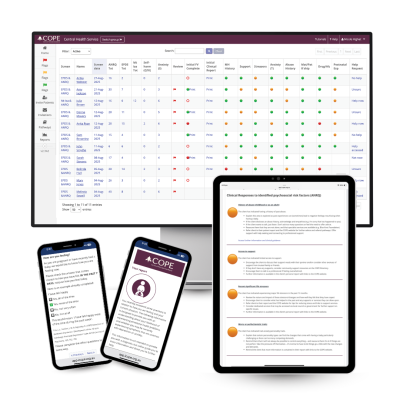
iCOPE 2.0 incorporates both the Antenatal Risk Questionnaire and the Edinburgh Postnatal Depression Scale. It also provides automated tailored clinician and patient reports and resources.
Ensuring 100% accuracy in scoring, iCOPE 2.0 facilitates efficient, cost-effective and private screening.