Trying to conceive

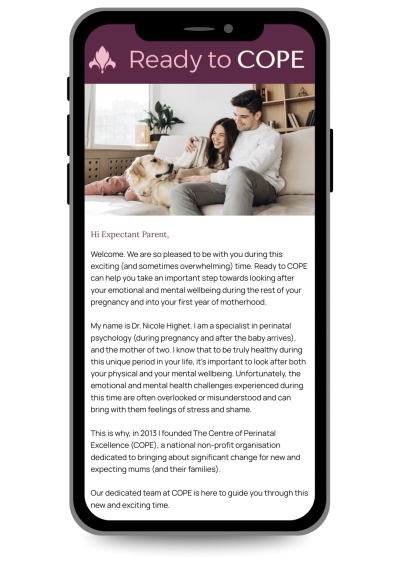
At COPE, we’re here for you from the very beginning. Access trusted guidance, expert information, and compassionate support as you navigate the journey of trying to conceive.

Coping with loss

Coping with loss is deeply personal and painful — COPE offers gentle support, guidance, and understanding to help you navigate this difficult time.

Pregnancy

Navigate your pregnancy with confidence using COPE’s expert advice, emotional support, and reliable information tailored for every step of the journey.

Birth

Providing you with evidence based information to help prepare and nurture yourself before, during and following birth

New parents

Early parenthood can be joyful, challenging and everything in between. COPE provides you with expert guidance and real insights to help you feel seen and supported every step of the way.

Family, Friends & Community

Whether you're a partner, friend, or family member, COPE provides guidance and support to help you care for your loved one and yourself through every stage of parenthood.

Workplace support

COPE provides guidance and resources to help workplaces support the emotional wellbeing of expecting and new parents with care and understanding.

COPE Directory

If you're going through a tough time, you're not alone. The COPE Directory is a supportive first step toward finding the right help, close to home and tailored to your needs

About us

At COPE, we believe every parent deserves access to compassionate support and reliable information. Our mission is to raise awareness, reduce stigma, and empower families facing perinatal mental health challenges.

Get involved

Your support can make a lasting impact. By donating to COPE, you help to provide vital support, resources, and research for families facing perinatal mental health challenges. Together, we can make sure no parent is alone.

Getting help

Understand when to seek help, how to take the first step of talking to someone, types of support available, plus how to find specialised perinatal mental health support near you.

Am I experiencing postnatal anxiety? 

While the challenge of managing a new baby is likely to bring some level of stress and anxiety in fathers from time to time as you take on new adjustments to your life and an increasing sense of responsibility, generally this will be transient, and feelings will pass on their own with time.

If, however, you are feeling ongoing tension, worry and stress that’s making it difficult to function from day to day, then you may be experiencing anxiety.

Symptoms of postnatal anxiety

Anxiety is the broad term used to refer to a range of conditions which have a number of common symptoms including:

  • Feelings of fear and worry which begin to ‘take over’ your thinking

  • Feeling irritable, restless, tense or constantly ‘on edge’

  • Racing heart/strong palpitations or a tightening of your chest – sometimes leading to panic attacks

  • Reoccurring worrying thoughts such as that you are not a good parent or that something terrible will happen

  • Unable to sleep – even when you have the opportunity

  • Avoiding situations for fear something bad will happen.


Some people experiencing anxiety feel like they are ‘going crazy’ or ‘losing their mind’. This is because the racing thoughts that keep coming back causing distress are leading to physical and emotional symptoms.  This can be made worse if you haven’t been getting enough sleep that can also be interrupted with a new baby.

How common is anxiety

If you are experiencing a number of these symptoms, then you are not alone.  

Anxiety is the most common type of mental health problem affecting one in five men in their lifetime. This is particularly the case if you have experienced anxiety in the past, although for some this may be the first time that you have experienced anxiety. 

Anxiety self-check

Take our free and anonymous Anxiety Self-Check

Anxiety in fathers and partners

Can anxiety and depression co-occur? 

It is also very common to experience anxiety and depression at the same time.  In fact, in up to 50% of cases these two conditions co-occur.  Thankfully the treatments for both conditions are similar and can treat both conditions at the same time.

The range of different types of anxiety disorders can be safely and effectively treated. It is recommended that you seek help for anxiety early – so that you can identify and ‘nip it in the bud’, rather than wait until any worrying thoughts and feelings start to take over.

Find out more about:

Find help for anxiety

Getting anxiety under control can improve your quality of life and overall experience of parenthood with your new baby.

Find help for anxiety

Your postcode
Logo with background color
Be safe online
Dismiss Alert

Click the Exit Site button or press "Esc" on your keyboard to exit this site quickly. Click here to learn how to keep your identity safe online.

Quick exit
Hide