Trying to conceive

At COPE, we’re here for you from the very beginning. Access trusted guidance, expert information, and compassionate support as you navigate the journey of trying to conceive.

Coping with loss

Coping with loss is deeply personal and painful — COPE offers gentle support, guidance, and understanding to help you navigate this difficult time.

Pregnancy

Navigate your pregnancy with confidence using COPE’s expert advice, emotional support, and reliable information tailored for every step of the journey.

Birth

Providing you with evidence based information to help prepare and nurture yourself before, during and following birth

New parents

Early parenthood can be joyful, challenging and everything in between. COPE provides you with expert guidance and real insights to help you feel seen and supported every step of the way.

Family, Friends & Community

Whether you're a partner, friend, or family member, COPE provides guidance and support to help you care for your loved one and yourself through every stage of parenthood.

Workplace support

COPE provides guidance and resources to help workplaces support the emotional wellbeing of expecting and new parents with care and understanding.

COPE Directory

If you're going through a tough time, you're not alone. The COPE Directory is a supportive first step toward finding the right help, close to home and tailored to your needs

About us

At COPE, we believe every parent deserves access to compassionate support and reliable information. Our mission is to raise awareness, reduce stigma, and empower families facing perinatal mental health challenges.

Get involved

Your support can make a lasting impact. By donating to COPE, you help to provide vital support, resources, and research for families facing perinatal mental health challenges. Together, we can make sure no parent is alone.

Getting help

Understand when to seek help, how to take the first step of talking to someone, types of support available, plus how to find specialised perinatal mental health support near you.

What is Hyperemesis Gravidarum, or HG?

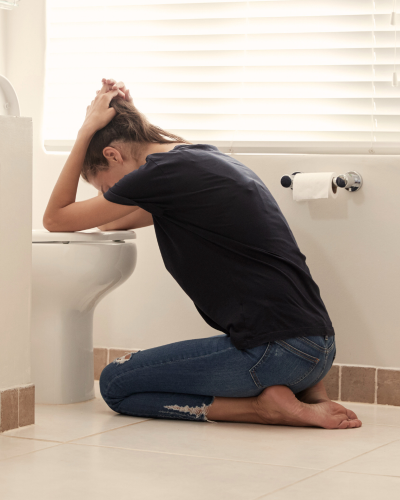
Hyperemesis gravidarum (HG) is characterised by severe and persistent nausea and vomiting that significantly impacts daily life. It affects around one to three per cent of pregnancies and can be both physically and emotionally challenging.  For some women, symptoms resolve during the second trimester. Others, however, experience HG up until delivery.

What might cause Hyperemesis Gravidarum?

While there have been numerous theories regarding the cause of HG - including HcG levels, nutrient deficiencies and increased sensitivities to taste and smell - it is only in the last few years that researchers have been able to point directly to a likely culprit. 

GDF15, or Growth Differentiation Factor 15, has been identified as a potential biomarker for hyperemesis gravidarum (HG). GDF15 is a protein that is naturally produced in the body, particularly in response to tissue injury, inflammation, or stress. Recent studies have found that GDF15 levels are significantly elevated in women with HG compared to those with normal pregnancies or mild pregnancy-related nausea and vomiting.

Impacts of HG

HG in pregnancy is real and can have a significant impact on a woman’s quality of life.

As well as coping with the physical effects of HG in pregnancy, women are often unable to work or care for older children and can require hospitalisation for treatment of severe dehydration. For some women, hyperemesis gravidarum can be so severe they choose to terminate their pregnancy.

As someone who has always been very independent, fit and healthy, with high energy levels and a good pain/illness tolerance, it has been very difficult to convey to others just how much I am honestly struggling and how debilitating it is. I have continued to push through, and have tried to not complain but to my own detriment as I feel as though I have at times masked the severity of my HG- only for some to realise once I have been hospitalised just how depleted I am.

(COPE, 2022).

Nausea and vomiting in pregnancy self-check

This self-check is designed to help you assess how extreme your symptoms of nausea and vomiting are during pregnancy.  This can help you to identify when it might be time to seek help and also track changes in your symptoms over time.

HG PUQUE Scale Self Check

Hyperemesis Gravidarum and perinatal mental health

Research has found that having severe morning sickness increases the risk of depression both during and after pregnancy. In fact, one study found that nearly half of women with HG in pregnancy suffered antenatal depression (depression during pregnancy). Nearly 30 per cent had postnatal depression. Some women also reported thoughts of self-harm.

It’s important to know that if you find yourself struggling emotionally as you battle hyperemesis gravidarum, you’re not alone. Many women describe feeling miserable that their pregnancy hasn’t been the way they expected it to be and worried about how they’ll cope with a new baby after nine months of ill-health and exhaustion.

As I laid in the hospital bed and looked down at my emaciated body, fighting the urge to vomit yet again, I kept thinking how this was all wrong. I wasn’t supposed to feel this way. My body wasn’t supposed to be reacting like this. This wasn’t the pregnancy experience portrayed by social media, apps, or articles, and it certainly wasn’t the pregnancy experience I had envisioned for myself.

Sofía Muñoz Abou-Jaoudé

The need for greater awareness of HG in pregnancy

Research undertaken by COPE highlighted the debilitating impacts of HG in pregnancy, which were often not well understood by others.  This included family and friends of women themselves who experienced HG, as well as workplaces who were unaware of how to support a colleague or team member suffering with HG in the workplace.  This need for greater awareness and understanding of hyperemesis gravidarum also extended to health professionals.

These findings prompted the inclusion of the emotional and mental health impacts of HG in pregnancy as part of COPE’s #thetruth campaign.  Further information about the key research findings, people’s stories, and information for workplaces and health professionals looking to provide support for others can be found on #thetruth webpage.

The living hell of Hyperemesis Gravidarum - Caitlin's story

"Imagine that all the things that filled your days have been taken away and in their place all that is left is crippling nausea, constant vomiting, food and smell aversions, anxiety, depression and suicidal ideation."

Read Catilin's story
The living hell of Hyperemesis Gravidarum Caitlins story

How to cope with Hyperemesis Gravidarum

Tips and advice from those who’ve been there

  • "Find a doctor who will take your concerns seriously – and keep trying until you do. It’s not “just in your head!” and you are not “just lazy.” Discuss treatment options including medications that can help you manage the symptoms."
  • "Join a support group on Facebook or an online forum. These can help you feel less alone and are useful for suggestions on how to manage the symptoms. (No ginger biscuits!)"
  • "It’s okay to feel both awful AND happy to be pregnant. If you haven’t experienced hyperemesis gravidarum it’s hard to understand how miserable it can be."
  • "HG during pregnancy can have a significant impact on your partner as they can often feel helpless and are required to take on more work around the house/childcare. Make sure they have support too, and accept all offers of help from family and friends."
  • "Try to be kind to yourself, take each day at a time, and know that this too shall pass! Holding your baby makes it all worthwhile."
  • "Take one day at a time. Do not think about the entire pregnancy or it will be too overwhelming."
  • "If you have an older child, get others to help take care of that child so you can rest. It might be hard for women to ask for help but it's so important that they do ask and that they realise they have a right/need to ask for help. Seeing a psychologist was great for me."
  • "My OB organised my mental health care. Trying to find support and practitioners and schedule appointments was beyond my capabilities. Having someone act on my behalf and advocate for me was very helpful. I felt listened too without having to use the little energy I had to explain myself time and time again."
  • "Focus on small things, let others take care of everything else they can. It's ok to feel helpless. It's ok to feel that you don't want to be pregnant - that is separate to your love and want for your baby."

I felt guilty… I felt guilty about work, I felt guilty towards my child, I felt guilty towards my husband… and I felt angry with myself: ‘why can’t I do this?’ It would have been very nice if I could have spoken to someone other than my direct family. It doesn’t have to be solved, but it helps to talk about how you can deal with it.

Finding support for Hyperemesis Gravidarum

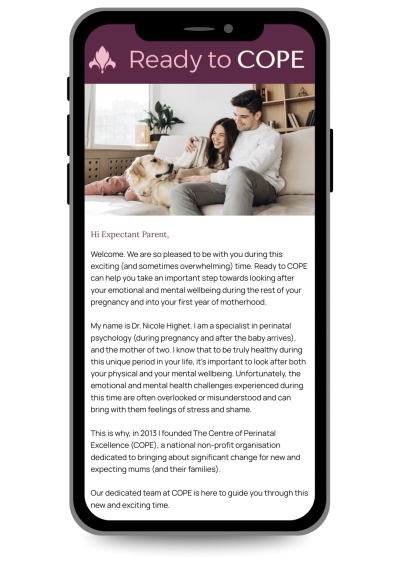
Sign up to receive the Ready to COPE guide for support and reassurance throughout your pregnancy.  This contains a special edition series for those suffering with hyperemesis. Developed in partnership with HG Australia, you will receive timely supportive advice to help you cope with the physical and emotional impacts of HG

While some women find chatting to other mums who have experienced HG in pregnancy helpful (no one will tell you to try eating crackers!) others find that professional support during pregnancy is invaluable too. Support can also be useful for managing anxiety around subsequent pregnancies.

Joining a support Hyperemesis Page on Facebook was a life saver for me. I felt so alone in my journey and when I connected with all these women that were feeling the exact same as me, I almost didn't feel as alone.

(COPE, 2022)

Stay informed and feel reassured

Now is a great time to sign up to Ready to COPE, which includes a special edition on Hyperemesis Gravidarum. 

Receive free, weekly supportive updates about your emotional health and mental wellbeing throughout pregnancy and your first year of parenthood.

Ready to COPE guide pregnancy and first year of parenthood

There are supports available for Hyperemesis Gravidarum.  This includes clinical support to help you manage with the symptoms and impacts of living with HG, as well as peer support from others who have been there, truly empathise and share tips and strategies to help you cope.  

You can find help on the COPE Directory. 

Find help and support for Hyperemesis Gravidarum

Your postcode
COPE Directory Map Support Block

More information on how to look after yourself in pregnancy

Be safe online
Dismiss Alert

Click the Exit Site button or press "Esc" on your keyboard to exit this site quickly. Click here to learn how to keep your identity safe online.

Quick exit
Hide