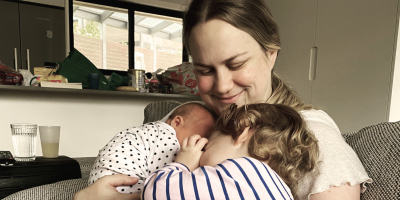
Caitlin shares her story of experiencing HG with both of her pregnancies in #thetruth campaign.
Describing what it’s like to live with HG to someone who’s never experienced it is a pretty hard task.
I get asked to do this pretty often and even though I’ve lived through it twice it’s still something I struggle with.
I think the best I can do is to ask you all to imagine the things in your life that make you ‘YOU’. The big things, like your work and hobbies, friends and family, your favourite music, books and TV shows. But also, the little things that contribute to making us all feel human: eating and drinking when we’re hungry or thirsty, exercising and sleeping, showering and brushing our teeth, even annoying things like paying bills or folding laundry or stacking the dishwasher. Imagine all the big and little things that make up your days, that fill your time and make you feel human and normal and like ‘YOU’.
Now, imagine that one day all of those things were taken from you. You can’t work or sleep or socialise or watch TV or make phone calls or do chores or brush your teeth.
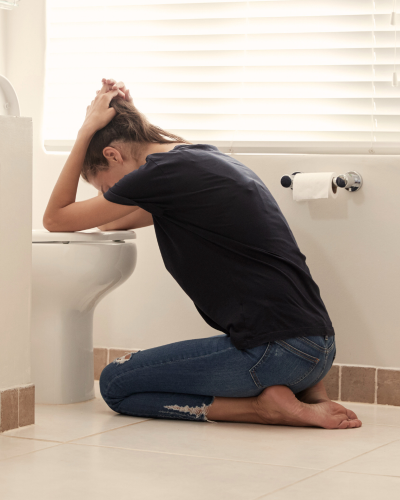
Imagine that all the things that filled your days have been taken away and in their place all that is left is crippling nausea, constant vomiting, food and smell aversions, anxiety, depression and suicidal ideation.
Now, imagine all of this is happening to you because of what the world will tell you is the best, most exciting thing that will ever happen to you – pregnancy.
I’m sure it’s very hard to imagine what that might be like – it’s a lot to consider and sounds, quite frankly, a bit crazy. But that really is the impact of HG on sufferers.
Personally, I never received an official diagnosis of HG from a healthcare professional. After presenting to ED at 9 weeks pregnant with my first baby after four weeks of vomiting 20 times a day and weight loss of over 6kgs I took to Google to try and make sense of what was happening to me. I read what little I could find and diagnosed myself – an incredibly common experience for HG sufferers. Next time I presented to ED I told the staff that I thought I was suffering from HG – one out of the seven people I spoke to knew what it was, she agreed with my self-diagnosis and that was that.
The physical health impacts of Hyperemesis Gravidarum
What followed was 30 more weeks of intractable vomiting and nausea. I lost 15kgs, tore through my oesophagus, broke so many blood vessels in my face that I permanently had two black eyes, passed out in public four times, and had 17 hospital admissions.
At 30 years old, newly married and after having lived out of home for a decade, my new husband and I had to move in with my parents. He had to work and I couldn’t be left alone. I had to shut down a business I’d spent years working to establish because at four months pregnant I just couldn’t get out of bed. I refused to refer to my unborn baby as anything other than ‘The Parasite’ because there was nothing good about being pregnant with her – just suffering.
During my first pregnancy I was on the receiving end of a lot of poor treatment at the hands of health care professionals. I have to believe that none of it was done maliciously, but simply came from a place of not knowing any better. While the entirety of my first pregnancy is littered with disappointing, degrading and downright ridiculous interactions with hospital staff there are a few stand out experiences:
The obstetric registrar who told me...
...to ‘think happy thoughts’ as a cure for, what was at that point, 30-weeks of non-stop vomiting and nausea. He offered this in place of IV fluids and a script for antiemetics
The psychiatrist who told me...
...that there was no mental health element to pregnancy or morning sickness and therefore he couldn’t help me. He suggested that, at 26-weeks pregnant, the only solution to my physical suffering was for the pregnancy to end. He then ended the conversation
The ED doctor who strongly suggested...
...to my husband that it was far more likely I was suffering from an eating disorder or subconsciously didn’t want my baby and was sabotaging the pregnancy by inducing my illness
It baffles me that it was far easier for this doctor to believe that my symptoms were psychosomatic and a result of my subconscious desire to end the pregnancy than it was for him to believe that there was a chance that ‘morning sickness’ may in fact continue beyond the magical 12-week mark.
Nausea and vomiting in pregnancy self-check
This self-check is designed to help you assess how extreme your symptoms of nausea and vomiting are during pregnancy. This can help you to identify when it might be time to seek help and also track changes in your symptoms over time.
The mental health impacts of Hyperemesis Gravidarum
If the physical toll of Hyperemesis Gravidarum doesn’t sound bad enough, then let me tell you about the mental anguish.
For most of my first pregnancy I passed the time by imagining how much better my life would be if I had just chosen to abort my much-loved and longed for baby; or if I’d had a miscarriage; or if I just simply ceased to exist. It’s hard to see a mother speak about her children that way, and it’s hard for me to publicly admit these things but I want you to have a sense of how great my physical suffering was.
I was so very sick that my mind turned against itself and went to a place that was so dark I was terrified of being left alone with my thoughts.
The only time I wasn’t thinking about ending my life or my pregnancy was when I was focussed on not passing out while vomiting, trying to stop myself from throwing up for long enough that I could keep my medication down, or trying to convince a doctor or midwife or nurse that I was sick enough to warrant their attention.
Anyone who has contemplated suicide or abortion will tell you that even if that thought is only fleeting and quickly quashed, it changes you. To this day, I look at my beautiful children and wonder how I could have imagined ending the pregnancies that resulted in them. I look around at my full and happy life and wonder how I could ever have wanted to leave it.
But that is the legacy of HG – it changes you forever in ways that you will continue to grapple with long after pregnancy is over. And I am one of the lucky ones.
The need for change
I started Hyperemesis Australia in between my two pregnancies. We are a charity that focuses on changing the way pregnancy sickness is experienced by sufferers and treated by practitioners. Every day I speak to women whose experiences, while totally unique, also totally mirror my own.
HG sufferers feel beaten down, invalidated, humiliated, ridiculed and broken by a system that is, often, intent on denying that the condition they’re living with even exists... This is not the introduction to parenthood that anyone deserves - and the reality is that it doesn’t have to be this bad for any of us.
HG sufferers accept that there is currently no cure for this horrendous condition – but that doesn’t mean any of us should be left to suffer alone, scared and silenced. If we are committed to supporting mothers and families, then why not start at the very beginning – by supporting them during pregnancy in whatever way they need.
Access to resources, support groups, educated and empathetic healthcare professionals, medication and other forms of symptom management must be the norm – and offered without forcing the patient to jump through hoops or prove they’re ‘sick enough’ to deserve it.
HG and pregnancy sickness set women, families and communities up for a disadvantaged start at parenting. It is simply unacceptable to allow any woman to spend even a moment contemplating suicide whilst pregnant, or terminating a baby they’ve dreamt of, hoped for and wished into the world – because of the impacts of a condition that we are well equipped to manage. Lack of education or resources can no longer be an excuse – the system must change and that starts here.
The facts about hyperemesis and mental health
Dr Nicole Highet, Doctor of Psychology (Clinical / Perinatal)

Hyperemesis Gravidarum is a very serious illness. Whilst the physical effects of the condition may be obvious, the emotional and mental health impacts are often not fully realised.
Research has found that having severe morning sickness increases the risk of depression both during and after pregnancy. In fact, one study found that nearly half of women with HG suffered antenatal depression (depression during pregnancy) and nearly 30 per cent had postnatal depression. Some women also reported thoughts of self-harm. Many women describe feeling miserable that their pregnancy hasn’t been the way they expected it to be and worried about how they’ll cope with a new baby after nine months of ill-health and exhaustion.
The significant, debilitating impacts coupled with the low awareness of the condition highlighted the need to include profile this issue as part of #thetruth campaign.
COPE together with Hyperemesis Australia continue to work to raise awareness of the HG, and together are developing specific resources to support the emotional and mental health needs of those suffering from HG and severe nausea and vomiting in pregnancy.
