The Edinburgh Postnatal Depression Scale (EPDS) helps identify possible symptoms of depression in the perinatal period, and is useful in identifying symptoms of anxiety.

What is the EPDS?
The Edinburgh Postnatal Depression Scale (EPDS) is a questionnaire originally developed to assist in identifying possible symptoms of depression in the postnatal period. It also has adequate sensitivity and specificity to identify depressive symptoms in the antenatal period and is useful in identifying symptoms of anxiety.
The EPDS is not a diagnostic tool. Rather, it is a screening tool that aims to identify women who may benefit from follow-up care, such as mental health assessment, which may lead to a diagnosis based on accepted diagnostic criteria (DSM-IV-TR or ICD-10).
Download EPDS screening tools
Translated versions of the EPDS have been validated in some languages.
How often should the EPDS be completed?
All women should complete the EPDS at least once, preferably twice, in both the antenatal period and the postnatal period (ideally 6–12 weeks after the birth).
The non-diagnostic nature of the EPDS, its purpose and the fact that it relates to the previous seven days (not just that day), should be clearly explained.
Calculating Edinburgh Postnatal Depression Scale scoring
The EPDS is a 10-item questionnaire. Women are asked to answer each question in terms of the past seven days. A score is calculated by adding the individual items, as indicated below, for each question (note some items have reversed scoring):
| Question | Scoring |
|---|---|
Question 1. I have been able to laugh and see the funny side of things |
Scoring As much as I always could (score of 0) |
Question |
Scoring Not quite so much now (score of 1) |
Question |
Scoring Definitely not so much now (score of 2) |
Question |
Scoring Not at all (score of 3) |
Question 2. I have looked forward with enjoyment to things |
Scoring As much as I ever did (score of 0) |
Question |
Scoring Rather less than I used to (score of 1) |
Question |
Scoring Definitely less than I used to (score of 2) |
Question |
Scoring Hardly at all (score of 3) |
Question 3. I have blamed myself unnecessarily when things went wrong |
Scoring Yes, most of the time (score of 3) |
Question |
Scoring Yes, some of the time (score of 2) |
Question |
Scoring Not very often (score of 1) |
Question |
Scoring No, never (score of 0) |
Question 4. I have been anxious or worried for no good reason |
Scoring No not all (score of 0) |
Question |
Scoring Hardly ever (score of 1) |
Question |
Scoring Yes, sometimes (score of 2) |
Question |
Scoring Yes, very often (score of 3) |
Question 5. I have felt scared or panicky for no very good reason |
Scoring Yes, quite a lot (score of 3) |
Question |
Scoring Yes, sometimes (score of 2) |
Question |
Scoring No, not much (score of 1) |
Question |
Scoring No, not at all (score of 0) |
Question 6. Things have been getting on top of me |
Scoring Yes, most of the time I haven’t been able to cope at all (score of 3) |
Question |
Scoring Yes, sometimes I haven’t been coping as well as usual (score of 2) |
Question |
Scoring No, most of the time I have coped quite well (score of 1) |
Question |
Scoring No, I have been coping as well as ever (score of 0) |
Question 7. I have been so unhappy that I have had difficulty sleeping |
Scoring Yes, most of the time (score of 3) |
Question |
Scoring Yes, sometimes (score of 2) |
Question |
Scoring Not very often (score of 1) |
Question |
Scoring No, not at all (score of 0) |
Question 8. I have felt sad or miserable |
Scoring Yes, most of the time (score of 3) |
Question |
Scoring Yes, quite often (score of 2) |
Question |
Scoring Not very often (score of 1) |
Question |
Scoring No, not at all (score of 0) |
Question 9. I have been so unhappy that I have been crying |
Scoring Yes, most of the time (score of 3) |
Question |
Scoring Yes, quite often (score of 2) |
Question |
Scoring Only occasionally (score of 1) |
Question |
Scoring No, never (score of 0) |
Question 10. The thought of harming myself has occurred to me |
Scoring Yes, quite often (score of 3) |
Question |
Scoring Sometimes (score of 2) |
Question |
Scoring Hardly ever (score of 1) |
Question |
Scoring Never (score of 0) |
Interpreting EPDS scoring
Clinical judgement is integral to interpreting EPDS scores, as in some cases the score may not accurately represent a woman’s mental health. For example, a woman may have a low score, even though there is good reason to believe that she is experiencing depressive symptoms. A very high EPDS score could suggest a crisis, other mental health issues or unresolved trauma.
Scores may be influenced by several factors, including the patients understanding of the language used, their fear of the consequences if depression is identified and differences in emotional reserve and perceived degree of stigma that is associated with depression.
When follow-up care is required
A total score of 13 or more is considered a flag for the need for follow up of possible depressive symptoms. In the antenatal period, repeat the EPDS in 2-4 weeks if a women’s score is 13 or more in line with clinical judgement. If the second EPDS score is 13 or more, refer to an appropriate health professional, ideally the women’s usual general practitioner. In the postnatal period, arrange referral or ongoing care if a women’s score is 13 or more in line with clinical judgement.
Follow-up may also be needed if scores on Questions 3, 4 and 5 suggest possible symptoms of anxiety.
For scores of 1, 2 or 3 on Question 10, the safety of the woman and children in her care should be assessed and, according to clinical judgment, advice sought and/or mental health assessment arranged.
Cultural considerations when using the Edinburgh Postnatal Depression Scale
Scores used to identify possible depression in Aboriginal and Torres Strait Islander and culturally and linguistically diverse populations are generally lower than those used in the general population.
For Aboriginal and Torres Strait Islander women, the score may be influenced by the woman’s understanding of the language used, mistrust of mainstream services or fear of consequences of depression being identified.
Translations of the EPDS developed in consultation with women from Aboriginal communities have been found to identify a slightly higher number of women experiencing symptoms of depression.
Cultural practices, such as attending the consultation with a family member, and differences in emotional reserve and the perceived degree of stigma associated with depression may also influence the performance of the EPDS in women from culturally and linguistically diverse backgrounds.
iCOPE 2.0: Best practice in perinatal mental health digital screening
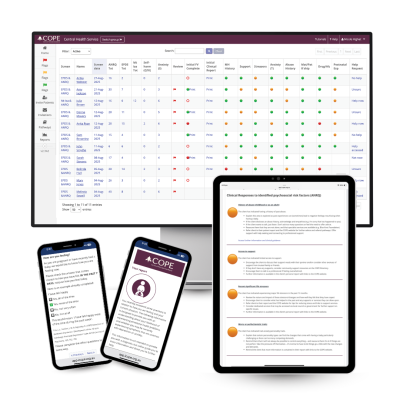
iCOPE 2.0 is an innovative digital screening platform that incorporates both the Edinburgh Postnatal Depression Scale and the Antenatal Risk Questionnaire.
iCOPE 2.0 ensures 100% accuracy in scoring, provides automated tailored clinician and patient reports and resources, and facilitates efficient, cost-effective and private screening.