Trying to conceive

At COPE, we’re here for you from the very beginning. Access trusted guidance, expert information, and compassionate support as you navigate the journey of trying to conceive.

Coping with loss

Coping with loss is deeply personal and painful — COPE offers gentle support, guidance, and understanding to help you navigate this difficult time.

Pregnancy

Navigate your pregnancy with confidence using COPE’s expert advice, emotional support, and reliable information tailored for every step of the journey.

Birth

Providing you with evidence based information to help prepare and nurture yourself before, during and following birth

New parents

Early parenthood can be joyful, challenging and everything in between. COPE provides you with expert guidance and real insights to help you feel seen and supported every step of the way.

Family, Friends & Community

Whether you're a partner, friend, or family member, COPE provides guidance and support to help you care for your loved one and yourself through every stage of parenthood.

Workplace support

COPE provides guidance and resources to help workplaces support the emotional wellbeing of expecting and new parents with care and understanding.

COPE Directory

If you're going through a tough time, you're not alone. The COPE Directory is a supportive first step toward finding the right help, close to home and tailored to your needs

About us

At COPE, we believe every parent deserves access to compassionate support and reliable information. Our mission is to raise awareness, reduce stigma, and empower families facing perinatal mental health challenges.

Get involved

Your support can make a lasting impact. By donating to COPE, you help to provide vital support, resources, and research for families facing perinatal mental health challenges. Together, we can make sure no parent is alone.

Getting help

Understand when to seek help, how to take the first step of talking to someone, types of support available, plus how to find specialised perinatal mental health support near you.

New parenthood can be different for everyone

The transition to parenthood is variable – for lots of reasons. For some, the transition appears smooth and without any major stress, with many new parents describing early parenthood to be enormously satisfying and what they expected. For others the experience is far from what they expected, as the demands of a new baby cause ongoing and constant stress, which at times can feel relentless and beyond your ability to cope.

When my baby came along, they were front and centre of my world. Everything I planned to do revolved around him. As a mum or dad that’s what you do.

Forgetting our own needs

As a new parent we may find ourselves constantly putting the needs of others first – whilst our our own needs and priorities can fall to the bottom of the list. Parenting is hard work. It is constant work. It is so easy to stop caring for yourself or to feel overwhelmed with the constant demands of a new baby.

Looking back, I now realise that I never made time for me, so my needs always came last. I ended up feeling drained, depleted and even a resentful towards my baby and other members of my family.

We need to remember though, that in order that we can continue to provide for those who need and constantly depend on us, we need to take care of ourselves. When you stop caring for yourself, your ability to care for your child is impacted and your ability to enjoy motherhood is also impacted.

For many, taking care of yourself requires thought and planning – as the demands of your baby and the day can tend to take over. Even taking a few minutes each day to put your needs first, can help reduce feelings of stress and frustration. It can also help you to recharge and replenish yourself, allowing you to feel more patient and positive in the way that you think and feel and even help to reduce the likelihood of mental health conditions.

Learn more about

Tips for taking care of yourself as a new parent

Allocate a window of time for you each day

The amount of time you can spare and when you make this time will depend on your own routine and demands. It may be when the baby has a sleep, or some parents will set their alarm to wake them early, so they have that space and time to themselves without interruption.

Take care of yourself physically

Eating well, exercising and resting will help to give you energy and feel strong and replenished – as opposed to drained and depleted.

Take care of yourself mentally

This includes reducing the level of stress by not putting unrealistic demands on yourself. Having a day planned with a loose structure can enable you to experience a sense of achievement without too much pressure. Be prepared to accept that some days nothing on the list is ticked off, so be prepared to let things go for a while. Find out more about coping with stress in early parenthood.

Take care of yourself emotionally

This includes acknowledging your feelings and having the opportunity to express yourself – even when you may have negative feelings. Remember, it’s normal to feel bad sometimes when adjusting to a new baby. Also, focusing on positive feelings that you have and times when you feel good and can give you clues to pick-me-ups. Sign-up to receive the Ready to COPE guide for timely advice and support.

Take care of yourself socially

Becoming a parent can be isolating, and lead to feelings of isolation and loneliness. Developing a support network that you can connect with, share experiences and provide mental and social stimulation can make a big difference to those ‘long days'.

What happens if I feel overwhelmed?

Whilst it is normal to feel stressed from time to time as you attempt to meet these constant and ongoing demands and changes, there may be times when you feel that things may be getting on top of you. It is normal that you will find it difficult to cope at times.

There may be times when you feel overwhelmed and as if you are reaching breaking point. If you find yourself in this situation a good strategy is to place your baby somewhere safe (for example, in their cot) and take a few minutes for yourself. Deep breathing, listening to a song that you find relaxing or calling your partner/a friend for support can all help to reduce your high levels of stress at the time.

If you are feeling this way frequently, and find yourself experiencing negative feelings towards yourself, your baby or life in general, talking to a heath professional can identify additional helpful strategies, support networks and/or identify whether you may be experiencing symptoms of depression, anxiety, or other postnatal mental health conditions.

Learn more about

How do I tell if my baby is okay?

For many new parents who have had little exposure to young babies, sometimes it is difficult to know what to expect and know what is normal in terms of your baby’s health and development – particularly in their first year of life. It is normal to feel unsure and want to seek reassurance.

If you find this to be the case, there are several helplines that can provide you with timely, helpful and practical advice regarding your baby’s health. Alternatively, your maternal and child family health nurse or GP can also provide you with helpful advice. This can be invaluable to provide you with reassurance or advise you when you may need to seek help from a health professional.

Some parents may find themselves in a position where they are frequently seeking such advice and reassurance from health professionals. In some cases, not all, this may be an indication you are experiencing postnatal anxiety, and this can cause you to be overly concerned and often perceive that something is wrong with your baby. It can be helpful to understand more about postnatal anxiety and identify whether this may be relevant to you and where and how this can be effectively treated.

Find help and support near you on the COPE Directory

Your postcode
COPE Directory Map Support Block

Receive supportive information

Parenting is constant and can be hard work. It is only by taking care of yourself, that you can continue to provide for those who need you and constantly depend on you.

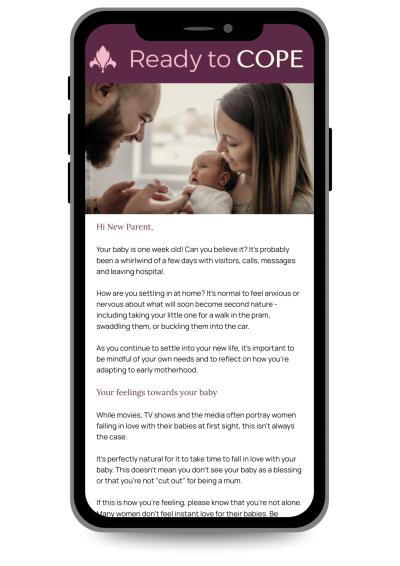
To receive timely, supportive emails throughout your first year of parenthood, we recommend that you sign up to our free guide for new parents, Ready to COPE.

Ready to COPE guide new parents
Be safe online
Dismiss Alert

Click the Exit Site button or press "Esc" on your keyboard to exit this site quickly. Click here to learn how to keep your identity safe online.

Quick exit
Hide